Singapore-based financial blog that aims to educate people on personal finance, investments, retirement and their Central Provident Fund (CPF) matters.

Friday, 18 August 2017

Save with CPF or Save with Fixed Deposits?

This post will contain a tip on how to increase your CPF returns, namely in the form of interest.
One way to earn more interest from CPF is to transfer your extra money, into your CPF Special Account.

The choice between CPF or Fixed Deposits is determined by how much flexibility you want.

The less flexible the option, the higher the interest.
Your Ordinary Account (OA) currently earns 2.5%, Special Account (SA) and Medisave Account (MA) earns 4% interest while your normal bank Fixed Deposit (FD) earns less than 2% annually.

Recommended Post: Yes! CPF takes 20% of your salary, BUT...

If you want to be able to touch the money (to spend or to do other things), putting it in a Fixed Deposit ensures that you will be able to use the money when the situation arises. 
Of course, this would mean you will be getting a lower interest.

But if you are confident that you do not want/need to touch the money and would like it to grow faster, depositing it into your CPF account makes sense and cents (many cents).
In addition, you will get tax relief if you top it up into your SA or Retirement Account (RA), which reduces the amount of tax you pay, double win!
The interest on your SA is double that of your FD. This works even better as you get older and approaches 55 because you are closer to the age you can withdraw money in your CPF accounts.

Real Life Example:
My mum is 48 this year. She wanted to buy a 10-year Fixed Deposit which gives less than 3% per year. I suggested that she put her money into her CPF to earn the CPF interest.

Based on her current age, she can put $7,000 into her SA and earn a 4% interest. She will be able to withdraw $5,000 when she reaches 55 years old in 7 years, or any amount in excess of her Full Retirement Sum (FRS).


Of course, if my mum fails to meet her FRS, the money that goes into her CPF will not be returned to her at the "end of the maturity" - instead, she will get it as future monthly payouts via CPF LIFE.
But there will be other factors to consider and there will be ways to withdraw the money out, which will be explained in future posts.
Recommended Post: If Li Ka Shing was 20+ years old now, he would....

All in all, if you wish to have a higher interest rate than Fixed Deposit and risk-free, you can consider putting your money into your CPF, especially if you are near 55 years old - where the risk-return profile is more skewed in your favour.


Remember to offer your opinions. If you don't put your two cents in, how can you expect to get change?

Have a feedback? Tell us now!
Subscribe to us or

Thursday, 6 July 2017

So many styles but which style?!


As times change, the markets change together with it as well. This is due to the forces that shape human behavior have changed and influences how people interact in the markets. From fundamental analysis to technical analysis, to leveraged trading such as contra trading, to computerised trading such as quant trading. With so many trading strategies and techniques in play, the question now is: Which is the one that is most profitable?

While most people are pre-occupied with just profits, it is far more important to know which trading style is suitable for your personality and risk tolerance. If you are comfortable using a strategy and are disciplined enough to stick to it, trading success will also follow.

Hence, the first step is to find your winning strategy. Getting to know all the various strategies, their advantages and risks. It is important to obtain and read as much resources as possible to widen the possible trading or investing tools that you can use to enhance your trading style. It can be through books, online resources, seminars or even through back-testing of your own formulated strategy. It could also be the case where not just 1 strategy is suitable, but rather a hybrid of 2 or more. Personally, I use fundamental analysis to identify potential investment options with viable target prices while using technical analysis to better time my entry and exit points.

Exclusively for our readers, we are glad to broadcast that ShareInvestors will be having a seminar by Ronald K, who is a self-made millionaire in the Stock Market. He will be introducing the Contra Squeezing strategies and trading using tick charts. Tick charts are just another way of presenting trading prices in charts, similar to line and candle charts. This is up to the preference of the traders using it as different charting styles present and focus on data differently. Ronald will also be introducing a risk management plan that is specifically for the Contra Trades.


Remember: Wealth is not about the money, it is about the options that it gives. Having more options to earn money will then generate more wealth.

Wednesday, 28 June 2017

WOOFR: Your Lifestyle Passport to Clubs, Bars & Music Events

What sort of applications and revelations does your platform bring about?

WOOFR is your lifestyle passport. Within a few taps on your smartphones, we bring you instant bookings and exclusive deals to your favourite clubs, bars and music events.


What inspired this business idea?
I’ve travelled regularly as a DJ, and I’ve seen so many pain-points in the nightlife space. It’s such a hassle for tourists to discover the best nightlife spots, and the language barrier makes it even harder to book a table or purchase tickets to the venue.
Nightlife venues themselves are still running on traditional methods of reservations (pen and paper), and they are unable to retain data analytics of their consumers such as the name, age, nationality and spending history.

More about WOOFR:
Facebook: @thewoofr
Instagram: @woofr_app
Website: thewoofr.com

This article is contributed by The Ventured.
We uncover and bring to our readers the success stories of entrepreneurs and also the hardship and hustle behind each of these success stories. Through these, we aim to foster strong entrepreneurship driven community and ultimately we wish to provide a one-stop solution in terms of guidance for our community. 

Facebook: @TheVentured
Insta: @the_ventured
Twitter: @The_Ventured

Tuesday, 13 June 2017

What you are missing out that the institutional investors are doing

19:37 No comments

As retail investors, we often perceive ourselves or by others as inferior investors that are incapable of obtaining superior returns as compared to institutional investors. This is partly due to the pre-conception that institutional investors are more sophisticated and knowledgeable where they can utilise complicated strategies with confusing instruments. However, with more and more articles that emphasized the ineffectiveness of active institutional funds and how passive funds are outperforming active funds, you may be swayed towards believing that active funds are lacking.

So how do we, retail investors who want to take on a more active investment approach, do to outperform the market benchmarks? 

Given their long establishment and experiences, active institutional funds do have established processes and frameworks that retail investors can exploit to improve their chances. 

1. Efficient employment of capital

Institutional investors often have large amount of capital. To maximise returns, it is also prudent to manage and ensure that a comfortable level of capital is employed for the purpose of earning returns. Evaluation of options to determine returns so as to effectively utilise capital is also important. Depending on choice of asset classes, level of capital usage also varies. From personal experience, in trading forex, 60-70% of capital should be employed consistently to ensure efficient use of capital to generate returns. Comparing to other asset classes like equities, this may be low but given the high leverage nature and buffer for margin calls, this would be sufficient. 

Just based on simple logic, by having most of your capital consistently employed and utilised to earn returns ensures a higher chance of out-performance.

2. Recording your investment thesis and reviewing when necessary

Institutional investors often record their investment thesis when they invest. This is important for the management and continuity of the investment strategy where new employees can easily understand and takeover an existing portfolio based on various reasons for investment. Another important step is to review the investment only if there are material changes in the investment scenario or market. Unlike retail investors, they are less likely to be impacted by daily price movements, which are erratic and random. This could be also possible due to the bureaucracy layered in an organization where it takes slightly longer than individuals to evaluate and make decisions. This is then one advantage of retail investors where we are more nimble and sensitive to capture investment opportunities. This means that we are able to get in at favourable prices. The tough part is, hence, to differentiate from the noises of the market (daily price fluctuations) and sticking to your investment plan.

From personal experience, all these noises are often the ones that distract me from the ultimate underlying price that I have for a specific investment. The market will often try hard to force you to move your positions and fake you out before moving exactly in the way you predicted. Thus, it is important to be able to differentiate what change is material enough for a change in investment stance.

3. Having co-investment officer
We could see that there are multiple successful funds that have 2 leaders to dictate investment strategies. Examples are PIMCO, KKR. Contrasting this to traditional leadership models where one individual will make the overall decision for direction. From personal experience, by having another investor that understands the overall investing strategy, it helps to keep one another in check for emotions such as greed and fear, as well as to promote accountability in managing other's funds, there are more detailed thought process in both investors before committing to a decision. Discussions are also conducted to discuss future strategies and evaluate investment options. 
Beside these techniques, what are the other ways you try to increase your investment returns? Share it here!


Friday, 9 June 2017

If Li Ka Shing was 20+ years old now, he would....


There was an article in the past that went viral.
It talked about the advice given to young people by Hong Kong's richest man - Li Ka Shing.
In the article, he talked about splitting our pay into 5 parts, each for a different purpose

Recommended Post: Yes! CPF takes 20% of your salary, BUT...

30% - Living Expenses, paying for food etc
20% - Socialising, paying off phone bill + creating connections
15% - Learning, buying of books or signing up for courses/training
10% - Travelling, going overseas once a year to broaden your horizon
25% - Invest, SAVE to INVEST or start a Small Business

He used a guy earning RMB 2,000 (roughly SGD $400) as an example of how to split the money.
His example is for people living in Hong Kong or in China.
In my perspective, there are some parts I think we can change to suit it to Singapore's context.

The allocation below is for a Singaporean whose take home pay is $1,500 after CPF deduction.
Some adjustments were made to the allocation and I do not recommend following strictly to the guideline because every individual is different and every month is different.
If you spend more on 1 month, make sure to balance it back the other month.
I think a little flexibility in the allocation is okay, but not too big a difference, less than 5% movement range for each category.
But do try and keep the last part (INVEST) intact or increase if possible, because that is for the future, YOUR FUTURE!

55% ($825) - Living Expenses, paying for food, transport etc (a)
10% ($150) - Socializing, paying off phone bill + creating connections (b)
10% ($150) - Learning, buying of books or signing for courses/training (c)
10% ($150) - Travelling, go overseas once a year to broaden your horizon (d)
15% ($225) - Invest, SAVE to Invest or start a Small Business (e)

Recommended Post: Yes! There is interest on your CPF Housing Grant, BUT...

a) The unfortunate part of not earning much is that a huge portion of our pay goes into necessities, rendering us with minimal for other things.
Items like groceries, utilities, meals etc often take up a huge portion of our pay.
Find ways to cut cost and keep them within the 55% budget!
DO NOT OVERSPEND!

b) Li Ka Shing advises us to treat 2 people who are able to help us in our career to a meal each month. Allocating about 3% of your pay to treat each person sounds reasonable. And hopefully, if your phone bill is not too expensive, it would probably be less than 5% of your pay

c) Singapore's National Library has got a good variety of books, thus there is not really a need to buy books. Save that money for other use, go to the library to borrow more books to read and learn.
There are also currently a lot of e-courses online that are free, some even available via YouTube. Do make use of these sites to learn and save on the learning expenses.
Of course, if a certification is required, then go for the paying courses that provide certificates.
The government is also providing a $500 subsidies for qualifying courses, make good use of it!
Money saved here should go to the 'Invest & Save' portion

d) Depending on your income, travelling every year might not be possible, unless it's to neighbouring countries. Either it is travelling every 2 years OR you could roll over your money to the Invest or Learning portion.

e) Read up on basic investments, long-term investments. Read up on our post on investment under our 'Investment' tabs to learn more!

Remember to offer your opinions. If you don't put your two cents in, how can you expect to get change?

Have a feedback? Tell us now!
Subscribe to us or

Wednesday, 7 June 2017

Singapore embraces Gender Diversity, but her Home Companies seems not...

How many female directors are there in Singapore's top 10 public companies?
While the number of female directors around the world is increasing, is the number of female board of directors in Singapore increasing?

Recommended Post: Yes! CPF takes 20% of your salary, BUT...


As we embrace gender diversity, should we start pushing for more female directors on our public companies' boards?
Especially when 3/10 of the companies have 0 female directors on their board.

Recommended Post: Yes! There is interest on your CPF Housing Grant, BUT...

Remember to offer your opinions. If you don't put your two cents in, how can you expect to get change?

Have a feedback? Tell us now!
Subscribe to us or

Sunday, 14 May 2017

Yes, CPF takes 20% of your Monthly Salary, BUT....

A lot of people have the misconception that the Central Provident Fund (CPF) takes away 20% of your salary every month.
While that is true, there is more to that than just what it seems like.
There are a few things you should know about this 20% "pay cut".

Recommended Post: Singapore Retirement, Re-Employment, CPF Withdrawal Age

1) The amount that you give actually decreases as you age
At the start, your contribution rate is 20% of your monthly salary
As you grow older, the percentage of your salary CPF takes decreases.
Source: CPF Board

2) There is a cap to your salary contribution!
Yes, there is a limit to how much you can INVOLUNTARILY contribute to your CPF.
Currently, the limit is set at $6,000.
If you earn $6,000 or less, your contribution rate is 20%. Meaning you only contribute $1,200 to your CPF.
However, if you earn more than $6,000, you are only required to contribute base on $6,000.
If you earn $10,000, you still only need to contribute $1,200 into your CPF. There is no need to contribute 20% of your extra $4,000 salary into your CPF (although you could if you want to).

3) Your Employer also contribute to your CPF
Your employer contributes 17% of your salary into your CPF.
This means you are actually getting an extra 17% of your salary - but it goes into your CPF.
This 17% is also cap at a monthly salary of $6,000, similar to your own contribution
If you earn $6,000, your employer contributes an extra $1,020 into your CPF (17% x $6,000)
If you earn $10,000, your employer also still contributes an extra $1,020 into your CPF.

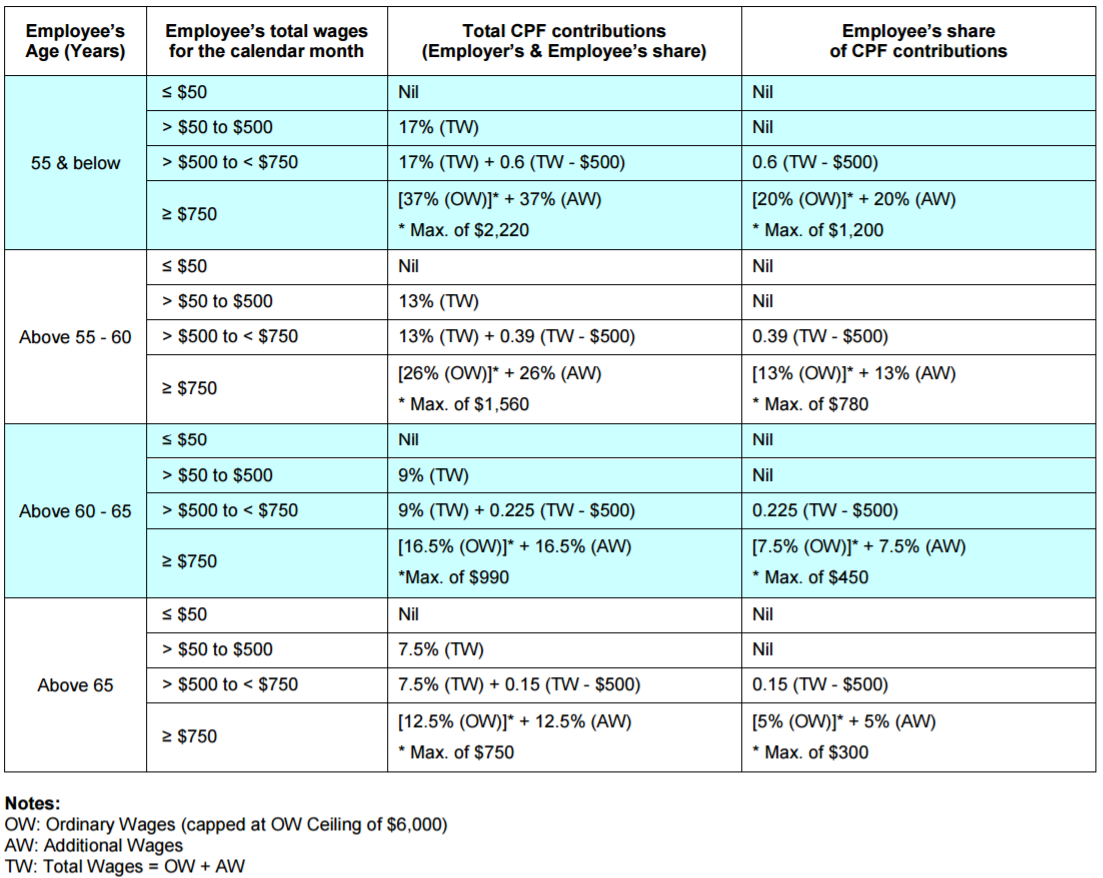
4) If your salary is below $750, your CPF Contribution is Different from others
If your monthly salary is below $750, your CPF contribution percentage is different from the normal CPF contribution rates
Source: CPF Board

Recommended Post: Yes! There is interest on your CPF Housing Grant, BUT...

Remember to offer your opinions. If you don't put your two cents in, how can you expect to get change?

Have a feedback? Tell us now!
Subscribe to us or