Singapore-based financial blog that aims to educate people on personal finance, investments, retirement and their Central Provident Fund (CPF) matters.

Showing posts with label Book Reviews. Show all posts

Thursday, 31 December 2020

Books I Read In 2020

These are the list of books that I have read this year.

They span from economics & politics to business & investment.

This is probably not a lot to some people, but it's quite a number for me (particularly cause I'm a slow reader).


How did I find the time to read these books?

Well, between my full-time work and blogging, I sacrifice sleep.

Yup, there's no secret "time hack" or "productivity hack", I just sacrificed sleep and forced myself to read about 1 chapter a day, and more if I can on the weekends.


So, let's start looking at what I've read and my reviews.


Investment


1. The Deals of Warren Buffett

Type: Non-Fiction, Investing

I self-proclaim myself as a Buffettologist (a follower of Warren Buffett's investing style).

This book goes through the deals the Warren Buffett made in his early days and how he analysed the various businesses before he invests in them.

Definitely a good refresh for someone like me who had read a lot of books on Buffett, and definitely a good start for someone who wants to learn how to invest like Warren Buffett himself.


2. Value.able

Type: Non-Fiction, Investing

This book was written by an Australian fund manager who specialises in value investing.

If you frequently attend ShareInvestor's annual INVEST fair, you would probably have seen him around a couple of times.

It covers both the mathematical (how to calculate fair value, which uses a table that I've never seen before) and non-mathematical (what characteristics to look out for) parts of value investing.

If you want to add another methodology/calculation formula to your value investing arsenal, this is one book you can read.


3. Beat The Crowd

Type: Non-Fiction, Investing

I'm a huge fan of everything Ken Fisher writes.

What he writes is quite different from what is usually written in investment, economics, or finance books.

In this book, he focuses a lot less on the tactics (read his book 'Debunkery', which has a lot of great investment tips), and more on the mindset of how an investor should have and how to think.

I'll probably rate this in the top 3 among all the books he has written. 

My personal favourite/top is still his 'Debunkery'.


4. Why Moats Matter

Type: Non-Fiction, Investing

A pretty good book, one that had me taking down a lot of notes because it was all about the tips and things to look out for when finding moats in businesses.

The first half of the book was spent explaining moats while the second half delved into the moat-characteristics to look out for in each specific industry.

Pretty useful if you are looking at certain companies to invest in and want to have a checklist to verify if it is a good company to invest in.


5. The Greatest Trades Of All Time

Type: Non-Fiction, Investing

A book that walks you through the history of the stock market, specifically on the top traders that made a lot of money in the financial markets.

The book introduces you to the top 10 famous traders who made a huge return in the financial markets, and how they did it.

Kind of like reading a summary of the various books that explained how each trader (people like George Soros) made their killing in the financial markets during the various different moments in time.


6. Charlie Munger The Complete Investor

Type: Non-Fiction, Investing

I have to admit, this book is quite dry, it became quite a struggle to finish it towards the middle of the book.

Basically, this is a no-math guide to value investing.

It talks about all the soft aspect of a good company and a lot about the mentality an investor should have.


Business


7. The Amazon Management System

Type: Non-Fiction, Business

This is one of the books that I'll probably re-read some time again in the future because everything inside is GOLD!

It's probably the best book I've read this year.

It talks a lot about what makes Amazon a successfully company, and how other companies can model themselves against one of the largest companies in the world.

Whether you're an employee, a small business owner, or a large company executive, this book is definitely a recommended read!


8. The Upstarts

Type: Non-Fiction, Entrepreneurship, Business

A book on Uber and Airbnb, how they got started, and how they became the giant they are today.

It's a really interesting read; it brings you into the companies and into the respective founders' heads.

It really explains the whole "do first, ask for forgiveness later" mentality, and maybe, just maybe, that should really be the way to go in the future?


9. Why I Left Goldman

Type: Non-Fiction, Banking, Business

Based on a true story (or at least that's what the author says), this book will show you the cultural change that took place in Goldman Sachs before the Great Recession of 2008. 

Of course, this is based on 1 man's narrative of the whole situation, and culture is something that impacts everyone differently.

But it is still an interesting read nonetheless (I have a friend that read this several times already 🤷‍♂️).


10. Hit Makers

Type: Non-Fiction, Marketing, Business

This is probably a recommended-read for those in business and in marketing. 

It explains a lot about how something can go viral, become iconic, or become a legend; while others languish, crash, or go unnoticed.

Master marketing and business will flourish, or at least that's what I got out of this book. 

This is another book that successfully made it into my "will read again in the future" list 👍.


11. Hit Refresh

Type: Non-Fiction, Business

The book by Microsoft CEO, Satya Nadella, on how he took over the role of CEO and successfully changed the culture of Microsoft to become what it is today.

Inside, he wrote about his early years, his time at Microsoft, and what problems he faced when he took over as CEO.

It's quite a light read, nothing technical; mostly about the man's life and the road he sees ahead for the company and the tech industry.


12. Reed Hastings Building Netflix

Type: Non-Fiction, Business

The story of Netflix, how it started, who started it, how it grew, and where is it going.

All answered in this short ≤200 book.

A pretty nice read, kind of like a biography of both the founder and of the company.


Economics


13. Confession of an Economic Hitman

Type: Non-Fiction, Economics

This will probably be a pretty interesting read if I had not read Dan Brown's Origin before starting on this book.

After reading a fiction novel, it makes this book feels like a fiction novel too.

Not to mention it felt like a book that consists of many conspiracy theories all wrapped up into one.

Could be true, could be false, but you pretty much can't tell because it is almost like a one-man narrative of what's happening around the world.

If you want to read a non-fiction fiction story, I guess this is the book to go? 🤷‍♂️🤣


14. The Undercover Economist Strikes Back

Type: Non-Fiction, Economics

Do you believe that the free market is the best way to rescue an economy or believe that Government intervention is the best way to rescue an economy?

This book will tell you why both are a viable way of rescuing an economy, along with many other lessons about economics, like sticking prices etc.

And, I'm actually quite interested to read the previous book the author wrote before this book.


15. Big Debt Crises

Type: Non-Fiction, Economics

A book by Ray Dalio that can be finished in 1 afternoon.

Recommend that you read the appendix first before the book. The appendix is more useful than the bulk of the book. 

The appendix explains the principles while the whole book is just examples of economic crises faced by countries over the years - it gets quite repetitive after a few examples actually.


16. Saving Capitalism

Type: Non-Fiction, Economics

This is a book by Robert Reich, former Secretary of Labour under Ex-US President Bill Clinton. 

If the above title doesn't ring a bell, maybe this might: he was recently called a "modern day moron" on Twitter by Tesla CEO, Elon Musk 😉.

I spent quite some time reading this book, and it's not because it's a tough read. 

Rather, it is because I disagree with the book so much, I had to spend time making notes of what this book was trying to say, and time to joint down points I disagree with and why.

In fact, I might publish the list of points that I disagree with in this book, maybe in another post in the future. 

This is probably one of the books that I had the most number of disagreement with 🤣.
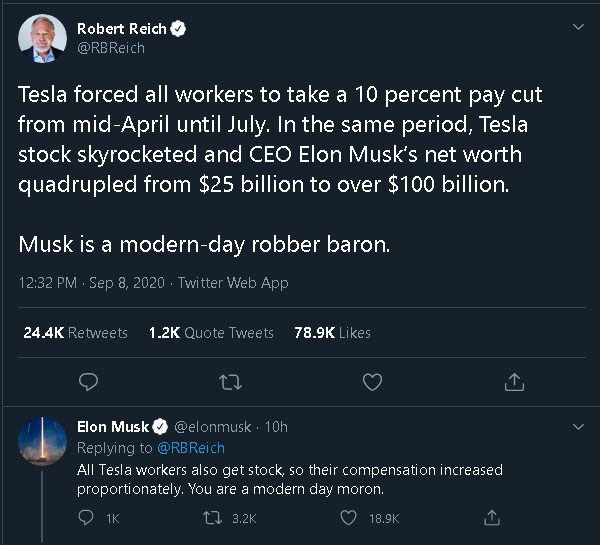
Source: TECH TIMES


Politics


17. Third World To First

Type: Non-Fiction, Politics

This is the X number of books I have read on or by The Man himself. 

It is an interesting book on Lee Kuan Yew's view on Singapore and the world during the time 1965 to 2000. 

A lot of him recounting the things that happened, how he assessed the situations and did what he did.

It's a man's view on history, and if you like history, then probably this book would interest you.


Fiction


18. Origin

Type: Fiction

The latest book by Dan Brown (although it is still several years old already).

Bookmarked for the longest time, so it was probably time to finish this up.

Doesn't disappoint!


Conclusion

As 2020 come to a close, did you learn or grow as a person?


Recommended Read: Get Free $8+ By Signing Up For Google Pay
Promos & Referrals
We are starting to build a list of Promos and Referrals for our readers.
Hey You!

If you have a money related story about you or your relatives' that you want to share, let us know in the comments below or email us at investmentstab@gmail.com.
Alternative, you could fill in the form below for us to contact you.
Story Form

Dear Reader!
As we progress towards the next phase of our journey, we would like to find out what would make you like us even more.
We hope you could help us fill in a short survey of 8 questions (4 of them are MCQs) so that we can help tailor our content to you.
Survey

Remember to offer your opinions. 
If you don't put your two cents in, how can you expect to get change?
Have feedback? Tell us now!
Follow us on Facebook and Instagram for more timely updates about finance-related articles and memes! 😁

Subscribe to our newsletter too in case social media platforms decide to stop showing you our content.

Saturday, 17 September 2016

What we know about risk is all wrong

The chance that an investment's actual return will be different than expected. Risk includes the possibility of losing some or all of the original investment. Different versions of risk are usually measured by calculating the standard deviation of the historical returns or average returns of a specific investment. A high standard deviation indicates a high degree of risk.

Read more: Risk Definition | Investopedia https://www.investopedia.com/terms/r/risk.asp#ixzz3qE2I9SPs
Follow us: Investopedia on Facebook

As you can see from the above, Investopedia defines clearly what risk is. Schools preach on what risk is, how it is calculated and how it is quantified. But after reading this book, I am questioning the method that we were taught.

Recommended Post: Singapore Finance Minister on Personal Finance Part 2

The book I am recommending today: The Most Important Thing: Uncommon Sense for the Thoughtful Investor by Howard Marks.
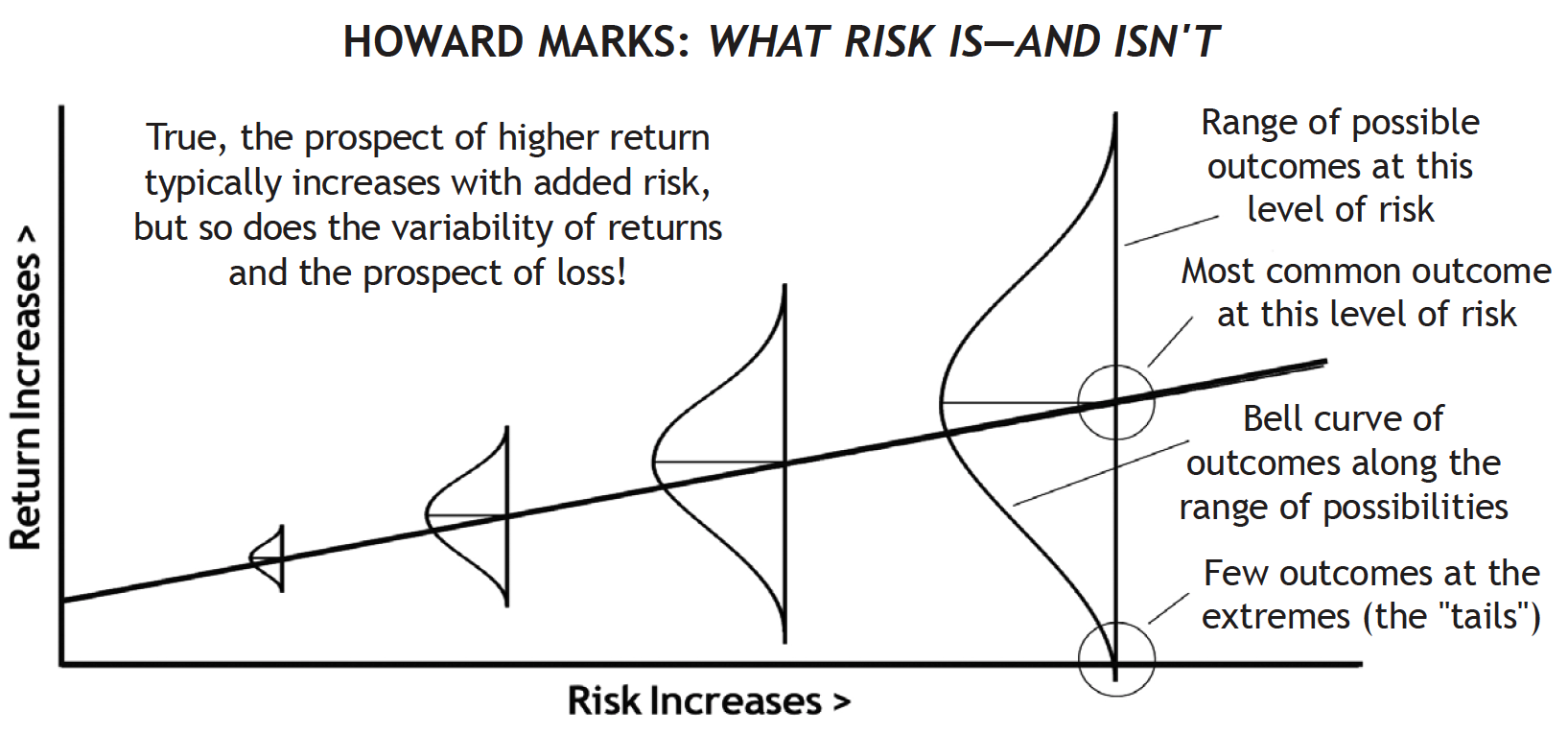
Honestly, from just skimming through the content page and back cover recommendations, this book looks like any other investment and finance book which "sells" you on conventional knowledge offered in many other books. However, what it presents is a wealth of knowledge that average investors do not note. An example of such is the following definition of risk, defined by the author himself, Howard Marks.

However, what Howard Marks came out with, was this diagram above. While the general theory of higher risks equates to higher returns, he adds in 1 more variable into this consideration. The higher the risks, the higher the median of each rate of return and the greater deviation of the possible rate of return.

This basically means the higher your risks, the higher the chances of your expected rate of return fluctuates.

Recommended Post: Thoughts on the Government Audits

I came to realise the significance of this after taking a while to digest but I feel that it is something important to account for and not just taking unnecessary risks without accounting the consequences of it.

Share and tell us some of your opinions on the above. Remember to offer your opinions. If you don't put your two cents in, how can you expect to get change?

Have feedback? Tell us now! 

Subscribe to us or 

Tuesday, 22 March 2016

Berkshire Hathaway 2016 Annual Letter

Key Lessons by Warren Buffett to Investors in his annual Shareholder Letter.
Same as with last year, we summarised some of the key points to note from the Legendary Investor's Annual Letter to his Shareholders (and fellow investors!)
The full 2015 annual report is available HERE.
Key lessons for 2014 available HERE.

MORE LINKS
Can't Hit CPF Retirement Sum?
4 Things to know About Withdraw $ from CPF
5 Financial Things to do in your 20s
6 Points your CPF is like your Bond Portfolio
Reducing CPF Housing Accrued Interest
5 Things about CPF Nomination YOU SHOULD KNOW


1) Low Growth? No Problem - as long as population growth remains low.
2% annual economic growth coupled with 0.8% annual population growth means a net 1.2% per capita growth, and such growth is actually good enough - especially when compounded over long periods like over a decade.


2) Life today is better than John D Rockefeller's times - even though he had more money.
We enjoy a better standard of living today than the past: medical, transportation, communication, entertainment, etc.
How the wealth will be distributed, however, would continue to be the problem that needs to be solved by the government.


3) Efficiency means increasing output per hour of employment
Productivity is linked to prosperity.
It allows for more goods and services to be created with less manpower required, allowing more people to do other things, creating new goods and services.
While many have lost their jobs to machines, this is inevitable improvements that will occur to improve society as a whole.
Examples are given in his report:

     a) Farming Industry
         1900 America - 11 million worked in the farming industry, 90 million acres of land devoted to corn farming yielding 30 bushels per acre.
         2015 America - 3 million working in the farming industry, 85 million acres of land devoted to corn farming yielding 150 bushels per acre.

     b) Rail Road Industry
         1947 America - 1.35 million worked in the railroad industry, revenue ton-miles of freight moved by Class I railroads that year totalled 655 billion.
         2014 America - 187,000 working in the railroad industry, revenue ton-miles of freight moved by Class I railroads totalled 1.85 trillion.
         The improve in productivity resulted in a 55% inflation-adjusted price drop for moving a ton-mile of freight.

     c) Energy Industry
         1999 Iowa - Berkshire Hathaway Energy unit acquired Iowa utility. It produced 19 million megawatt-hours of electricity while employing 3,700 people.
         2015 Iowa - Berkshire Hathaway Energy unit Iowa utility produces 29 million megawatt-hours of electricity while employing 3,500 people.
         The increase in efficiency allowed BHE to not raise prices for 16 years while the industry rate increased by 44%.


4) "the early bird gets the worm, the second mouse gets the cheese."


5) 2016 Annual Shareholder Meeting can be watched Online
Berkshire Hathaway's 2016 Annual Shareholder Meeting will be streamed online for the first time on https://finance.yahoo.com/brklivestream .
Date of the meeting is April 30th 9am (US time).


For more on Warren Buffett letters, see below:


Remember to offer your opinions. If you don't put your two cents in, how can you expect to get change?

Have feedback? Tell us now! 

Subscribe to us or 
Follow us: Investment Stab on Facebook

Tuesday, 17 November 2015

What we know about risk is all wrong

As you can search in Google, Investopedia defines clearly what risk is. Schools preach on what risk is, how it is calculated and how it is quantified. But after reading this book, I am questioning the method that we were taught.

MORE LINKS
CPF Voluntary Contribution Rates
What to Own during Rate Hikes?
Fine Print of CPF Money Withdrawal
5 Financial Things to do in your 20s
Singapore Finance Minister on Personal Finance Part 2
Repaying CPF Accrued Interest - Why?
Reducing CPF Housing Accrued Interest

The book I am recommending today: The Most Important Thing: Uncommon Sense for the Thoughtful Investor by Howard Marks.

Honestly, from just skimming through the content page and back cover recommendations, this book looks like any other investment and finance book which "sells" you on conventional knowledge offered in many other books. However, what it presents is a wealth of knowledge that average investors do not note. An example of such is the following definition of risk, defined by the author himself, Howard Marks.

The diagram above shows the typical risk and return ratio that school generally preaches about, whereby higher risks should equate to higher returns and vice versa.
Source: bnpparibasmf

Source: Sound Mind Investing

However, what Howard Marks came out with, was this diagram above. While the general theory of higher risks equates to higher returns, he adds in 1 more variable into this consideration. The higher the risks, the higher the median of each rate of return and the greater deviation of the possible rate of return.

This basically means the higher your risks, the higher the chances of your expected rate of return fluctuates. 

I came to realise the significance of this after taking a while to digest but I feel that it is something important to account for and not just taking unnecessary risks without accounting the consequences of it.

Share and tell us some of your opinions on the above. Remember to offer your opinions. If you don't put your two cents in, how can you expect to get change?

Have feedback? Tell us now! 

Subscribe to us or 

Sunday, 27 September 2015

5 things that you need to start doing to improve your financials during your early 20s

Most people in the early 20s would think that they still have a long way before retirement and financial planning is too "kewl" for them. Contrary to that, early financial planning can go a long way. This is especially due to the power of compounding. Well, here are 5 things that you NEED to start doing to improve your financials during your early 20s.

MORE LINKS
GE Effect on STI
Raising of Re-Employment Age to 67
Singapore Finance Minister on Personal Finance Part 1
Singapore Finance Minister on Personal Finance Part 2
Getting out of CPF Retirement Sum

1. Tracking your expenses

This is one of the most important things that you should do as part of a personal finance regime. Without tracking where your money is flowing to, you can never find excess money that is going to redundant spendings. It is also a good habit to have is when you are constantly tracking your expenses, it creates a conscious psychological mental note that you should be spending within your budget. You will also feel the pinch.

There are multiple expense manager apps out in the market which provides lots of functions such as visual display of your spending. It is also extremely convenient as you can just log an expense in it anytime. 

2. Using automated recurring transfer for savings

I was discussing the topic of savings with a friend and there were some interesting pointers that I wish to share. Initially, I was using a model where "Income - Expenses = Savings". My reasoning was to keep the savings as high as possible while maintaining expenses low. However, the other side of it is to maintain a fixed amount of savings. This is to ensure that there is a minimum amount kept for savings.

With technology, this is now increasingly easy. You can use Internet Banking to set up the automatic transfer at specific times of the month. So simple!

3. Making use of credit card rebates and various promotions

Many people seem to take credit cards as a finance taboo. It is one of the best tools that you can use to increase your savings and even earn rewards. However, this requires some discipline whereby you must pay the bills promptly at the end of the month or the interest when compounded could be hefty.

Based on your income and age group, there are several credit cards out there in the market which you can apply for. Anyway, this could be potentially a whole new topic on which credit card offers the best rewards, but for more information, here is a site which you can visit: https://www.moneysmart.sg/credit-cards

4. Reading up to increase your financial literacy

It is extremely important to increase your financial literacy. Heard of the saying that knowledge is omnipotent? It not only opens you up to the different tools which you can use for investment but you can also adjust it accordingly to suit your risk tolerance. Most importantly, you get to have choices.

As suggested previously, here is a book which we recommend reading:


5. Get out of debt

As cliche as this might get, the fastest and fool-proof way to get returns on your money is to repay your debts and your returns will be the interest that is owing to your debt.

Debt management is critically important for financial success. Besides the cost of an education and a primary residence, if you can't pay cash don't make the purchase. As far as education and the home, pay off the education before you buy the home.

As for the home, do not stretch your budget. Buy what you can easily afford and pay it off. Luckily for Singaporeans, there is a robust system in place in terms of CPF and the housing loans are carefully structured. Source for one that suits you in terms of its repayment schedule and are within your payment means.

Bottom line

Having the right mindset and attitude is the most important. Once you have these, you will be well on your way to building a secure financial future. While the journey is long and the road not always easy, be sure to take the time to appreciate what you have. It is also crucial to savor the small victories which will help you stay on your long-term course. After all, you earned it.


Remember to offer your opinions for if you don't put your two cents in, how can you expect to get change?

Have feedback? Tell us now! 

Subscribe to us or 

Follow us: Investment Stab on Facebook

Monday, 18 May 2015

The Automatic Customer

Today I will be sharing a book that I recently read.
I think that this is a really good book that is worth sharing to our readers, even though it does not belong to any of our blog category.
This book is more of a "business start-up" book than a "investment/personal finance" book.

Personally, I don't buy books because I believe that a public library provide really good resources for free - better save the money and invest more.
But, there are certain books that I believe are worth buying.
Mary Buffett's 'The Warren Buffett Stock Portfolio: Warren Buffett Stock Picks: Why and When He Is Investing in Them' and 'Warren Buffett and the Art of Stock Arbitrage: Proven Strategies for Arbitrage and Other Special Investment Situations' are examples of 2 books that I bought because I think that they are simple to understand important concepts and beautifully written.

The book I'm sharing today is: The Automatic Customer, Creating a Subscription Business in Any Industry.
It contains a lot of real subscription businesses and plenty of advice on how to start one.
The book gave me several ideas on what businesses that I could start with some of the business model in the book - there are many kind of subscription model.


If you would not like to buy the book, I urge you to at least borrow it from your nearest library, because this is a really good book to read.

Remember to offer your opinions. If you don't put your two cents in, how can you expect to get change?

Have a feedback? Tell us now! 

Subscribe to us or 
Follow us: Investment Stab on Facebook

Monday, 16 March 2015

Key Points of Warren Buffett 2014 Letter to Shareholders


We understand that a lot of our readers do not have the time to read through the whole annual letter by Warren Buffett, the best investor of all time.
As such, we have summarized the key points of his annual letter below for the benefit of our readers! :D
We have only summarised points that we think are important for the average investors.
As majority of the annual letter relates to Berkshire Hathaway specifically, we were able to eliminate a huge part of the letter to the below 7points.
Do read and learn from the Sage of Omaha!

1) Berkshire Hathaway will now not only compare growth in its book value against price growth of S&P500 but also compare Berkshire's market value increase against the S&P 500 price increase.

2) Definition of Investing: "the transfer to others of purchasing power now with the reasoned expectation of receiving more purchasing power - after taxes have been paid on nominal gains - in the future."

3) "...it has been far safer to invest in a diversified collection of American businesses than to invest in securities - Treasuries, for example - whose values have been tied to American currency (has fallen by 87% from 1964-2014)."

4) For majority of the investors, "a diversified equity portfolio, bought over time, will prove far less risky than dollar-based securities (treasuries, etc)." This is the best strategy for investors with long-term goals like retirement, with no need to rely on the money for short-term needs.

5) Investors should not fear price volatility. Volatility is dangerous if investors are investing for short-term purposes. However, over the long term, volatility has always been working in the investors' favour.

6) Ways to destroy long-term investors' portfolio:
       a) active trading
       b) attempting to "time" the market
       c) inadequate diversification
       d) paying huge fees to fund managers & brokers
       e) use of leverage

7)"Cash, though, is to a business as oxygen is to an individual: never thought about when it is present, the only thing in mind when it is absent." Always keep sufficient cash reserves for raining days - individual or business.

For a full version of the letter, please click on the link below:
http://berkshirehathaway.com/letters/2014ltr.pdf

For more on Warren Buffett letters, see below:


Sunday, 15 March 2015

How ETFs are changing the world of activists (Inspired by an article in Economist)

This post is inspired by an article that was in the Economist, edition dated 7 - 13 February. You may read the following article here: http://www.economist.com/news/briefing/21642175-sometimes-ill-mannered-speculative-and-wrong-activists-are-rampant-they-will-change-american

While this is just a sub-topic of the entire article, I believe this would likely be the future of our market if more investors turn towards passive investing via ETFs.

ETF investing may prove to be most rewarding to an investor where it requires the least effort but able to  replicate the market returns, which averages beat the average inflation rate. However, when you are investing into ETFs, the index fund uses your money to invest into the underlying basket of stocks. This means that while you have the ownership of the underlying companies' shares via the index fund, you are indirectly transferring the rights of these ownership to the index fund. This can known as the proxy voting which shareholders would receive every year to transfer their votes to another shareholder by filling up a proxy form. This may save the investor the trouble of managing multiple corporate-related actions, it can also have other implications.

Firstly, the index fund now has the power to change the board directors and influence other major corporate decisions. If the index fund is extremely large, this also means that the fund has huge voting powers that can predominantly change the company. While most passive funds often take a less active role, we can see that they are increasingly being more involved as they realised their responsibilities. As stated in the article, this is still mostly handled by proxy advisory firms, which may be ousted once large funds such as BlackRock and Vanguard start to handle themselves.

You might be thinking what could be the impact of the transfer of voting rights. For one, the index fund might unknowingly change the culture and values of the company if they handle without care. Index funds are usually one of the public shareholders and with their passive approach towards handling corporate decisions, they may be influence by activists via the proxy advisory firms. As such, board members could be changed, undermining the existing culture of the company and implement new disruptions to the companies' existing activities.

With the American market facing this issue, it is highly probable that our market will move towards it, given the popularity of ETFs among retailers.

Feel free to discuss any other topics below that you find interesting in the article as it is predominantly written on activist funds.


Monday, 9 March 2015

ETF Strategies


We talked about the benefits of investing in ETFs in the previous article.
Link to previous article:
Today, this article will be talking about the strategies that can be employed when using ETFs!
Personally, I am not a technical investor but a fundamental one.
Thus the strategies suggested will not require the use of technical charts etc.

For me, there is a passive approach and a slightly more active approach.
I think both strategies are suitable for investors who do not wish to take a very active role in their investment portfolio (changing only once every half yearly if required)

Strategy 1: Passive Strategy:
I would recommend a buy-&-hold strategy, investing in low cost ETFs that tracks the index (S&P500, Straits Time Index, Hang Seng, FTSE, etc).
You can choose to invest in your country's own index ETF or even better, invest in a global market ETF which tracks the whole world's stock market (allows you to capture the rising emerging market while owning the developed nations' market).
Some examples of global index ETFs include iShares MSCI ACWI Index Fund and Vanguard Total World Stock ETF.
Over the long-term, buy-&-hold still remain as a good strategy!
This can be like a savings plan, investing a little of your retirement savings into a index fund every month.

Strategy 2: Slightly Active Strategy
This approach requires a little more active role every quarter or half a year.
As per written in the books below, there are statistical evidence showing that every once in a while, certain sectors will tend to perform better than the others.
The approach to this is to invest in those sectors when it seems like the right time and try to get out before the sector cools off.
This is tough, especially in getting the timing absolutely right. As per my view, I always think that if I can capture just 50% of the full upside, it is good enough for me. Because I believe that I am never that smart to be able to buy on the absolute bottom and sell at the absolute top!
'Greed is good', over-confidence is not!
You could also use ETFs to invest in certain sectors/industry that you think might outperform the average. you could invest in ETFs that tracks that specific sector to capture that sector's upside.


Of course, which ever strategy you choose to use, it is always best to read up on them first.
I would recommend 2 books that I have read before below.
There are many more books around that are about ETF investing and sector investing.
I have read quite a few of them, but I would strongly recommend below 2.
I recommend reading both because 1 focus more on sectors than ETF while the other focus more on ETFs than sectors - they complement each other well.

For more on sectors than ETFs, this is the book:


For more on ETFs than sectors, this is the book:


These books can be borrowed from most public libraries!
Happy Investing! :D

Sunday, 28 December 2014

2015 will be a Great Investment Year

2015 will be a great investment year for everyone - if we buy the right investment.
Historically over the last 70 years, the third year of all US presidents have been the most positive year in the US stock market.


Photo from Kenneth L. Fisher's Market Never Forget, Chapter 7 - Poli-Ticking

Above is a photo shot I had taken from "Markets Never Forget", listing the stock market's (S&P500) historical returns since President John Calvin Coolidge, Jr . 

Since 1943, the 3rd year of all presidents have ended positive; that's 71 years worth of historical data and trend.


Well, you may ask, it is the US market that will be good, how does it benefit investors residing outside of US?

The surprising part is, the US stock market is actually positively correlated to most of the other countries' stock market, and the correlation has only been more positive instead of less. Thus it can be safely deduce that next year will be a good year for most global investments.

Photo from Kenneth L. Fisher's Market Never Forget, Chapter 8 - It's (Always Been) a Global World, After All

The above image is a shot I took from Ken Fisher's book. It shows the price correlation between S&P500 (US Market) and of MSCI EAFE Global Index (Global Markets). As can be seen, other than a few instances, most of the movements are positively correlated, except for the different percentage changes in price.

I think the best books that I have read that talks about all these economic/financial history and correlations comes from Ken Fisher's books - Debunkery & Market Never Forgets.
Ken Fisher (Kenneth L. Fisher) is the son of Philip Fisher (the author of the famous investment book - Common Stock & Uncommon Profit). He has been a Forbes columnist for more than 20 years and manages his fund (Fisher Investments) for an even longer period.

Ken Fisher's 2 books are both written in short chapters with plenty of historical economic data and charts that help investors see clearer the investment world. Eg: Bonds are safer than stocks but only to a certain period.

Both books are good reads to both new and seasoned investors.
I believe they are both available in public libraries.
Do read on them and improve your investment prowess! :D


Sunday, 21 December 2014

2 Must-Read for all New Investors

Today, I would like to recommend 2 books that I think are by far the best investment books I have read since I started investing.

Warren Buffett Stock Portfolio.
Warren Buffett and the Art of Stock Arbitrage

Both books are by Mary Buffett and David Clark.
They are easy to read and easy to understand for a new investor.

Warren Buffett Stock Portfolio explains how Warren Buffett identify which companies are great and worth investing in simple layman terms - Earnings Per Share (EPS) and Growth Rates. It comes with plenty of examples as well to aid in the understanding of them.

Warren Buffett & the Art of Stock Arbitrage explains the 7 strategies used by Warren Buffett to grow his wealth. Most of the 7 strategies are still applicable in today's world.

It is available in most public libraries and I would say is a must-read for all investors - new and old.
I recommend this to all my friends who are interested in investing because these 2 books have taught me a lot about investment, and I would recommend it to you too!